
Swiss Capital Markets: New Rules regarding Swiss Withholding Tax

•

Share on:

A bond issued by a foreign resident issuer but guaranteed by its Swiss resident parent company is reclassified as a domestic issuance and subject to 35 percent withholding tax if the proceeds raised under such bond are used in Switzerland. According to new rules which entered into force on 1 April 2017, it is possible to use the proceeds in Switzerland up to an amount equal to the equity of the foreign issuer and to still avoid a reclassification.

By Stefan Oesterhelt (Reference: CapLaw-2018-01)


1) Introduction

Switzerland levies a 35 percent withholding tax (Verrechnungssteuer) on interest payments with respect to bonds. International capital markets generally do not accept bond issuances subject to such deduction of Swiss withholding tax. As a consequence, it is common for Swiss multinational groups to issue bonds through a foreign subsidiary. This is accepted by the Swiss federal tax administration as long as the proceeds raised under such foreign issuance are used outside of Switzerland at all times while the bonds are outstanding. New rules which entered into force on 1 April 2017 added additional flexibility in this respect.

2) General Principles

A bond issued by an entity resident outside of Switzerland will be (re-)characterized as domestic issuance if such bond is guaranteed by the Swiss parent company and the proceeds from the issuance are used in Switzerland. In such a case, the Swiss guarantor will have to pay 35 percent Swiss withholding tax on any interest payments (53.8 percent in case of a gross-up) to the Swiss federal tax administration.

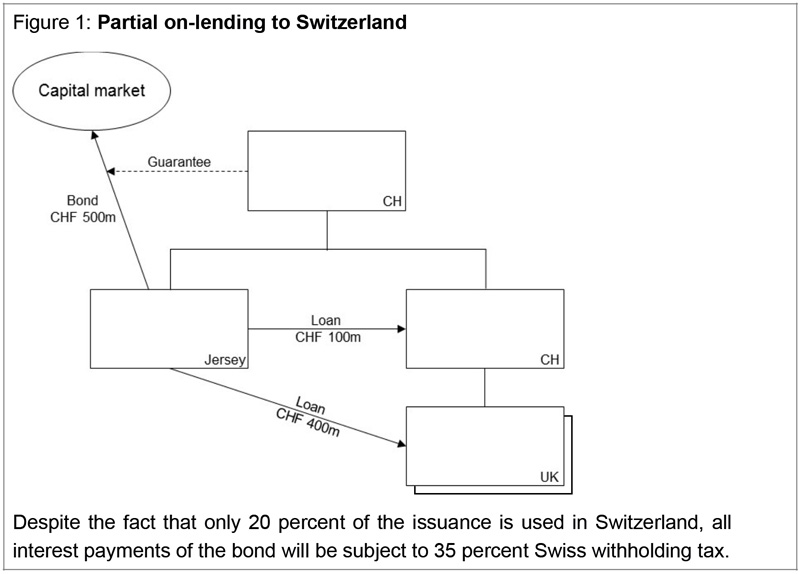
Any direct or indirect on-lending to a Swiss group company is considered as a potentially harmful “use of proceeds in Switzerland” for these purposes. In the case of such an “use of proceeds” in Switzerland, the bond will be reclassified in its entirety as a domestic issuance (see Figure 1).
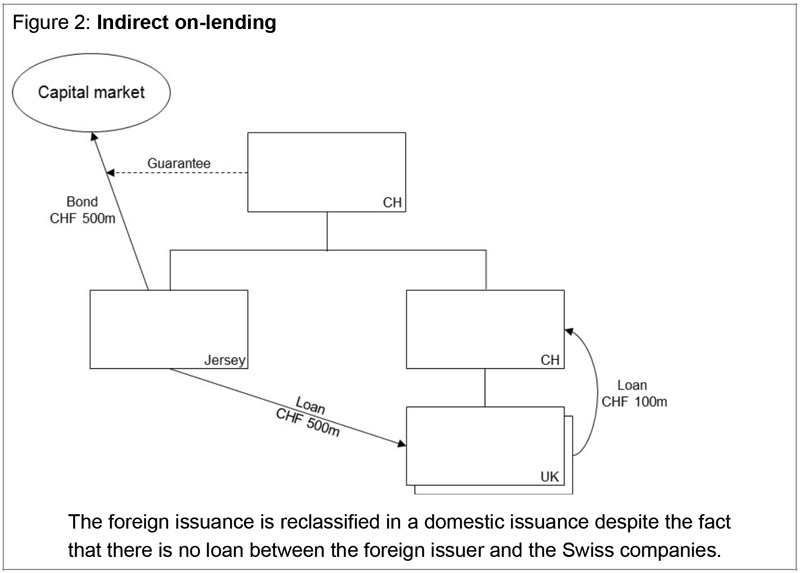
A foreign bond is reclassified in a domestic issuance subject to withholding tax even if there is no direct on-lending to Switzerland but an indirect on-lending to Switzerland (see Figure 2).
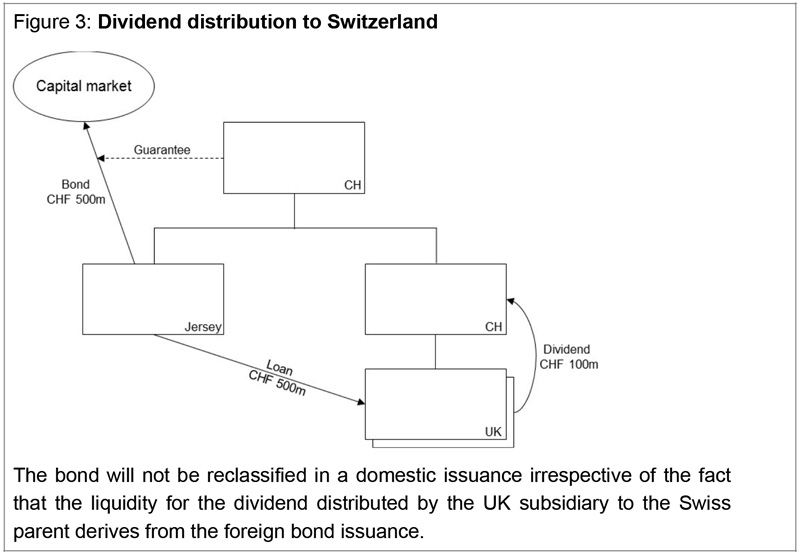
A use of proceeds in Switzerland is only potentially harmful if there is a (direct or indirect) on-lending to Switzerland. Equity contributions or dividend distributions are not harmful (see Figure 3).
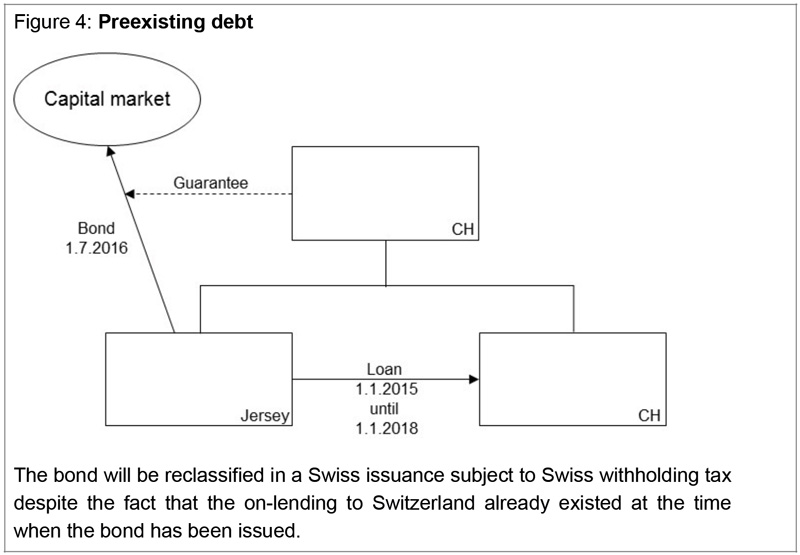
A connection between the foreign bond issuance and the on-lending to Switzerland is not necessary for such a reclassification of the bond. Even pre-existing on-lending to Switzerland is potentially harmful (see Figure 4).
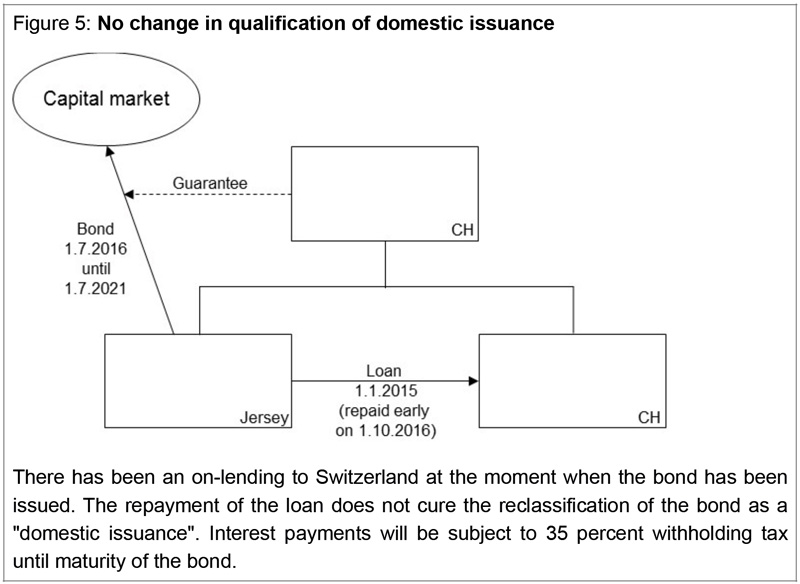
Once there has been a harmful “use of proceeds in Switzerland” and consequently a bond has to be reclassified as a domestic issuance, the bond will keep this classification until maturity (see Figure 5). A repayment of the on-lending to Switzerland does not cure the reclassification.
3) New Rules

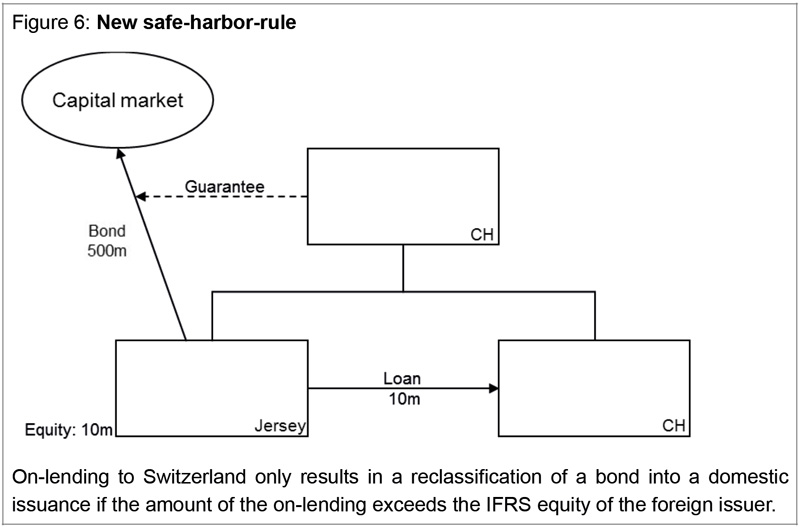
The rules which entered into force on 1 April 2017 introduce a new safe harbor rule for on-lending into Switzerland. Under this rule, it is permissible to on-lend to Switzerland up to an amount equal to the amount of the equity of the foreign issuer (see Figure 6).
Under the new rules, the equity of the foreign issuer at the end of the business year of the foreign issuer is decisive. Consequently, any on-lending to Switzerland which is repaid before year-end is not harmful (see Figure 7).
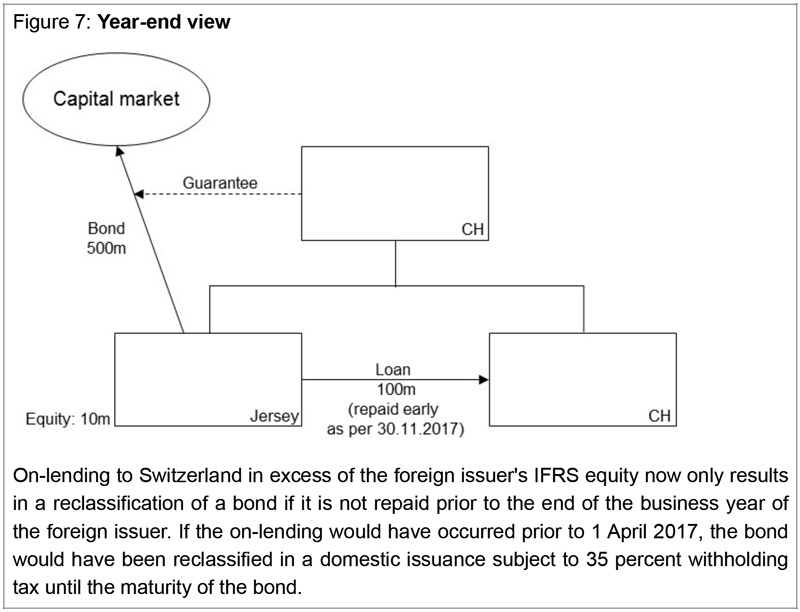
The new rule is subject to the abuse of law principle, however. The Swiss Federal Tax Administration would still reclassify a bond into a domestic issuance if the proceeds of the bond are used in Switzerland most of the time (but never over year-end date).

4) Appraisal

The general rule that on-lending to Switzerland is not permissible if a foreign issued bond is guaranteed by a Swiss parent company has not been given up by the legislative change which entered into force on 1 April 2017. However, the flexibility introduced with the new rules regarding intra-year on-lending as well as the new safe harbor rule is highly welcome.

Stefan Oesterhelt (stefan.oesterhelt@homburger.ch)

Discover more articles

We provide up-to-date information on legal and regulatory developments regarding the capital markets, publish concise articles on developments in the Swiss and international financial markets, and announce recent deals and forthcoming events.

  • FinSA Conduct Obligations: FINMA‘sRecent Enforcement Activity

    FINMA has intensified its enforcement of the conduct obligations governing individual financial services under the Financial Services Act (FinSA). The publicly communicated conclusions of two recent enforcement proceedings are good examples of interventions by the regulator under the FinSA conduct regime. Accompanied by FINMA Guidance 03/2026, which highlights recurring risk patterns, these cases signal that the conduct obligations are now firmly on FINMA‘s enforcement radar.


  • KAPITALMARKTRECHT IM FOKUS 2026 – CONFERENCE REPORT | 19 August 2026, SIX ConventionPoint, Zurich

    On 19 August 2026, practitioners, academics and market participants convened at SIX ConventionPoint in Zurich for Kapitalmarktrecht im Fokus 2026. Under the Title “Clarity or Room for Interpretation? Challenges in Interpreting Bond Terms and Conditions“ (Klarheit oder Auslegungsspielraum? Herausforderungen bei der Interpretation von Anleihensbedingungen), the conference examined how standardized bond terms should be interpreted, the interaction between contractual provisions and regulatory requirements and the significance of prospectuses, risk factors and changing market practice. Particular attention was paid to regulatory capital instruments and the Point of Non-Viability (PONV), against the background of the write-down of Credit Suisse AT1 instruments and the…


  • EHRA CLARIFIES REGISTRATION PRACTICE FOR CONDITIONAL CAPITAL WITHIN AND OUTSIDE THE CAPITAL BAND 

    In a practice note dated 27 August 2026, the Federal Commercial Register Office (EHRA) clarified the registration practice applicable where a company‘s articles of association provide for conditional capital both within a capital band and outside the capital band. This article sets out the resulting registration practice.


  • Swiss advisers subject to the Swiss Anti-Money Laundering Act: Scope and Duties

    Effective 1 October 2026, the revised Swiss Anti-Money Laundering Act will extend Switzerland‘s anti-money laundering framework to advisers participating professionally in covered transactions. Lawyers, notaries, fiduciaries, accountants, tax advisers, M&A advisers and other professionals may become subject to due-diligence, organizational and certain reporting requirements under the AML framework even if they do not execute financial transactions themselves. This article summarizes the new regime, its principal exemptions and its consequences for professional advisers.


  • The Impact of Article 21c CRD VI on Swiss Banks‘ Loan Portfolios

    Effective as of 11 January 2027, CRD VI introduces an EU-wide restriction on third-country institutions‘ cross-border lending activities. Under the new article 21c CRD VI, Swiss banks may no longer extend loans, provide guarantees, or make credit commitments to EU-domiciled borrowers without an authorized subsidiary or branch in the relevant member state. The prohibition covers all corporate finance activities with an EU nexus, including syndicated credit facilities.


  • DocMorris Finance B.V.‘s Issuance of CHF 96.8 Million Senior Guaranteed Convertible Bonds Due 2031 and Concurrent Repurchase of Outstanding Convertible Bonds Due 2028

    On 11 September 2026, DocMorris Finance B.V., a directly wholly-owned subsidiary of DocMorris AG (SIX: DOCM), successfully completed the private placement of CHF 96.8 million 1.5 per cent. senior unsecured convertible bonds due 16 March 2031, unconditionally and irrevocably guaranteed by DocMorris AG and convertible into existing and/or newly issued registered shares of DocMorris AG. Concurrently with the new issuance, DocMorris AG completed the full repurchase of its outstanding 3.0 per cent. convertible bonds due August 2028 with a nominal amount of CHF 49.6 million through privately negotiated bilateral transactions. The repurchased bonds will be cancelled. The transaction reduced the…