
A bond issued by a foreign resident issuer which is guaranteed by its Swiss resident parent company may be reclassified in a domestic issuance subject to 35 withholding tax if the proceeds raised under such bond are used in Switzerland. Under the rules which entered into force on 1 February 2017, it was possible to use the proceeds in Switzerland up to an amount equal to the equity of the foreign issuer. New rules which entered into force on 5 February 2019 added further flexibility with respect to the permissible use of proceeds in Switzerland.
By Stefan Oesterhelt (Reference: CapLaw-2019-44)
1) Introduction
Switzerland levies a 35 percent withholding tax (Verrechnungssteuer) on interest payments on bonds. International capital markets generally do not accept bond issuances with deduction of Swiss withholding tax. As a consequence, it is common for Swiss multinational groups to issue bonds through a foreign subsidiary. However, the Swiss Federal Tax Administration reclassifies such foreign issuance in a domestic issuance if the amount of proceeds used in Switzerland exceeds certain thresholds. While historically the proceeds had to be used outside of Switzerland completely, it was permissible to use the proceeds in Switzerland up to the equity of the foreign issuer since 1 April 2017 (see already Stefan Oesterhelt, Swiss Capital Markets: New Swiss Withholding Rules CapLaw 2017). A new guidance which has been published on 4 February 2019 by the Swiss Federal Tax Administration increases the amount which can be used in Switzerland considerably.
2) General Principles
A bond issued by an entity resident outside Switzerland will be (re-)characterized as domestic issuance if such bond is guaranteed by the Swiss parent company and the proceeds from the issuance are used in Switzerland. In such case, the Swiss guarantor will have to pay 35 percent Swiss withholding tax to the Swiss federal tax administration on any interest payments (53.8 percent in case of a gross-up).
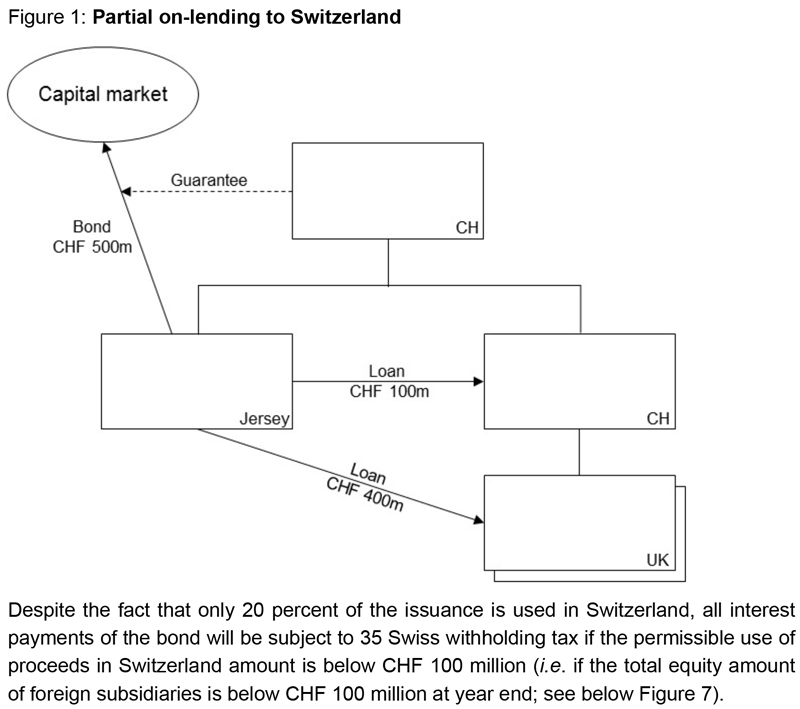
Any direct or indirect on-lending to a Swiss group company is considered a (potentially harmful) “use of proceeds in Switzerland”. If the “use of proceeds” in Switzerland exceeds the permissible threshold as described below, the bond will be reclassified in its totality into a domestic issuance (see Figure 1).
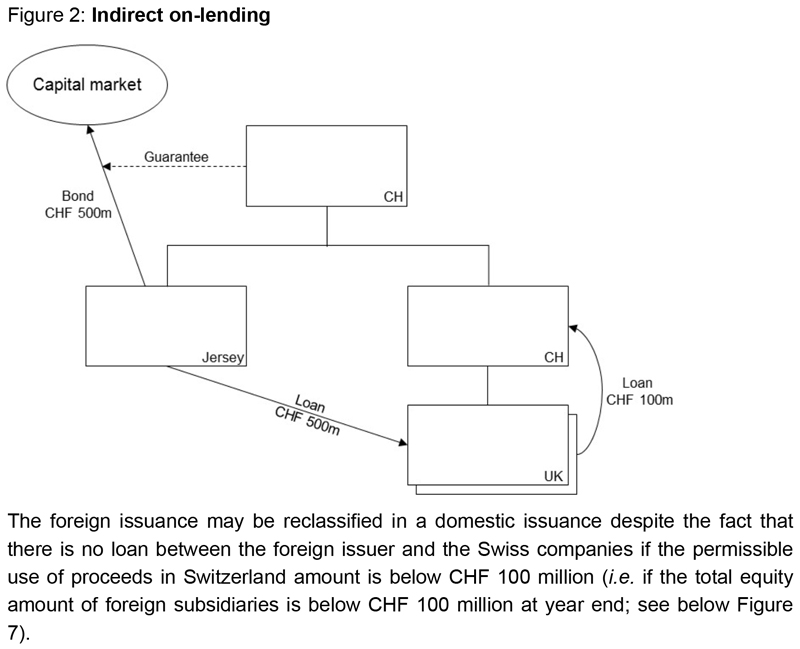
A foreign bond may be reclassified in a domestic issuance subject to withholding tax even if there is no direct on-lending to Switzerland but an indirect on-lending to Switzerland (see Figure 2).
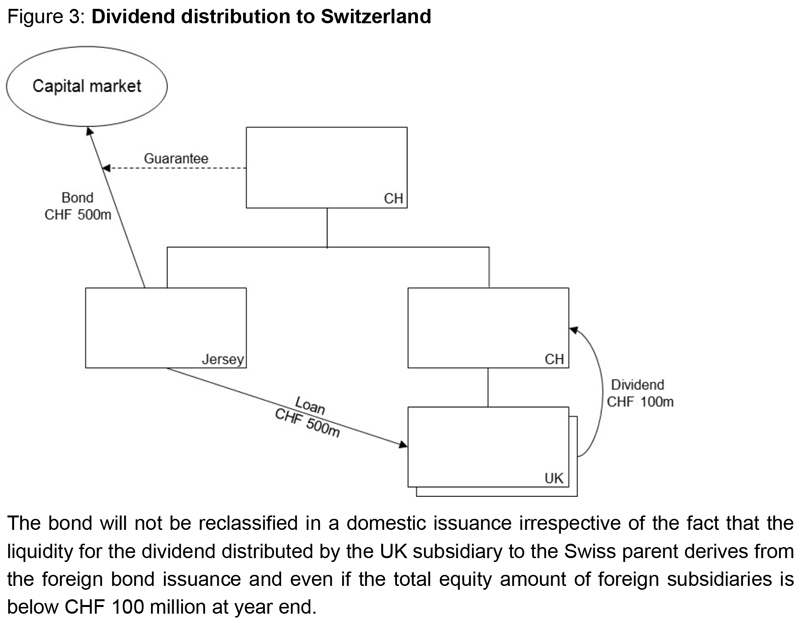
However, a use of proceeds in Switzerland is only potentially harmful if there is a (direct or indirect) on-lending to Switzerland. Equity contributions or dividend distributions are not harmful (see Figure 3).
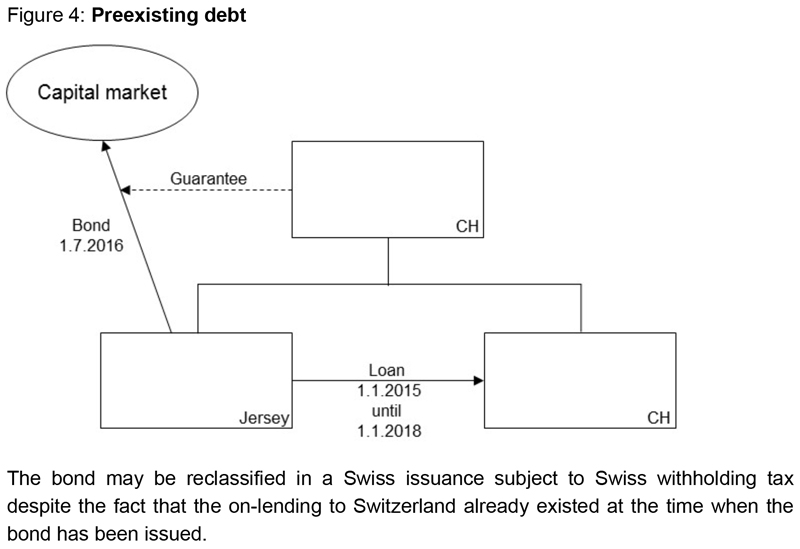
A connex between the bond issuance and the on-lending to Switzerland is not necessary for a reclassification of the bond. Even pre-existing on-lending to Switzerland may be potentially harmful (see Figure 4).
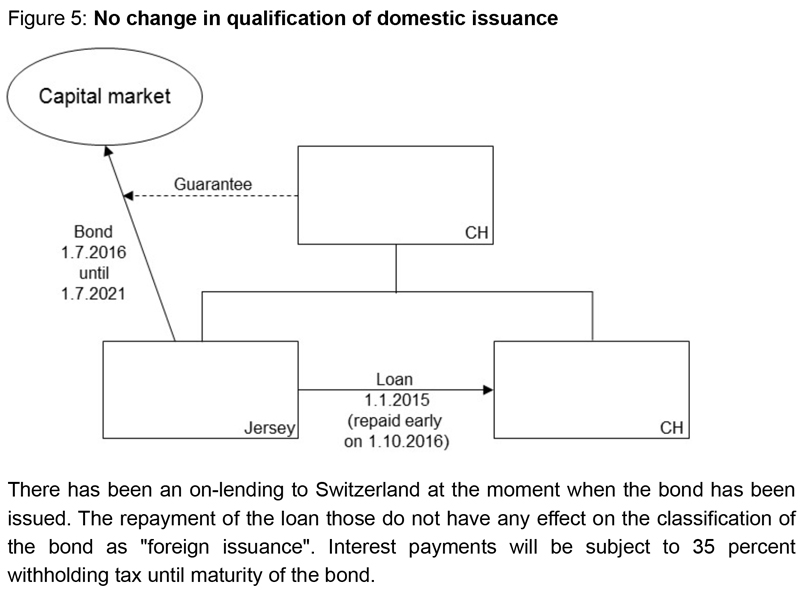
Once the “use of proceeds” in Switzerland exceeds the permissible amount at year-end and consequently the bond has to be reclassified in a domestic issuance, the bond will keep this classification until maturity (see Figure 5). A repayment of the on-lending to Switzerland does not have any effect.
3) Safe-harbour-rule of 1 April 2017
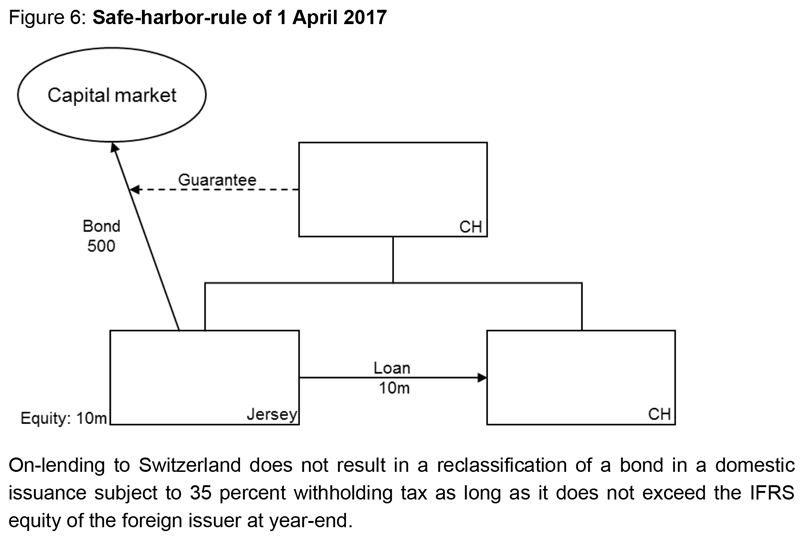
The rules which entered into force on 1 April 2017 introduced a safe harbor rule for on-lending into Switzerland. Under this rule, it was permissible to on-lend to Switzerland up to the amount of the equity of the foreign issuer (i.e. IFRS equity at end of business year of the foreign issuer) (see Figure 6).
An on-lending to Switzerland results in a reclassification of the bond only if it exceeds the equity of the foreign issuer at the end of the business year of the foreign issuer. Consequently, any on-lending to Switzerland which is repaid before year-end is not harmful (see Figure 7). This rule is subject to the abuse of law principle, however. The Swiss Federal Tax Administration would still reclassify a bond in to a domestic issuance if the proceeds of the bond are used in Switzerland in an amount exceeding the total equity of foreign resident companies most of the time (but never over year-end date).
While this rule is in principle still valid, there has been an extension as per the guideline of 5, 2019 (see below under 4).
4) New guideline of 5 February 2019
The Federal Tax Administration published a new guideline on 5 February 2019, which increases the permissible amount of use of proceeds considerably. Under this new guideline, it is permissible to on-lend to Switzerland up to the amount of IFRS equity of all direct and indirect foreign subsidiaries of the Swiss guarantor. Consequently, any on-lending to Switzerland which is at year-end below the sum of IFRS equity of all direct or indirect foreign subsidiaries of the Swiss guarantor does not result in a reclassification of the bond (see Figure 7).
All foreign subsidiaries which have to be fully or partially consolidated can be taken into account. The equity of foreign subsidiaries which are not fully owned by the Swiss group will be taken into account proportionally.
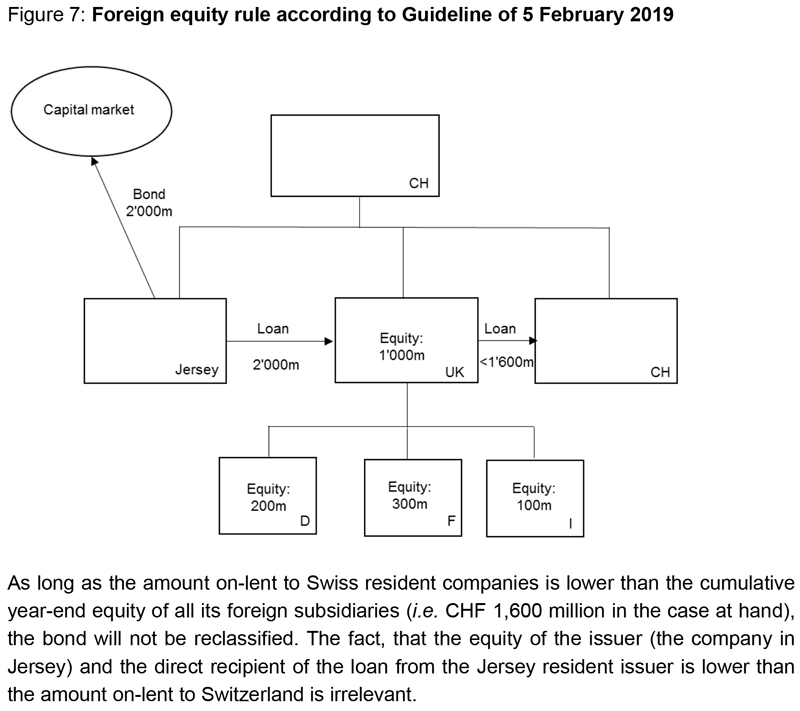
Furthermore, the net amount used in Switzerland is relevant. Any proceeds on-lend to Switzerland which will be further on-lend by the Swiss company to a foreign company will reduce the net amount used in Switzerland.

The guideline of 5 February 2019 states that this new rules are subject to an advance private letter tax ruling obtained from the Swiss Federal Tax Administration. This statements needs to be clarified. While in practice the capital markets will always request an advance tax ruling for transaction security purposes, an advance private letter ruling is not a condition per se to be eligible for the application of the practice published in the guideline of 5 February 2019.
The new practice published by the FTA on 5 February 2019 increases the flexibility of on-lending to Switzerland for Swiss multinationals considerably and is therefore highly welcome.
Stefan Oesterhelt (stefan.oesterhelt@homburger.ch)