
At an event held in January 2026 at the premises of SIX Swiss Exchange, a new white paper was presented that sets out the advantages of conducting an IPO in Switzerland as opposed to the United States. This contribution focuses on legal aspects covered in the white paper.
Estimated to be more than USD 200 billion, Switzerland‘s investor capital pool is second to none in continental Europe. Home to some of the world‘s leading universities, in particular ETH Zürich, and to some of the most innovative companies in tech, biotech, techbio, medtech, pharma, fintech, crypto and AI, Switzerland delivers a steady pipeline of potential IPO candidates – embedded in an ecosystem providing for a solid cluster of peers, easy access to talent and comprehensive financial analyst coverage.
On 29 January 2026, as part of an in-person conference addressed to IPO candidates primarily in the tech space (the Tech IPO Event) jointly hosted by Swisscom Ventures and SIX Swiss Exchange (together with SIX Exchange Regulation, SIX), Homburger and SIX presented a co-authored white paper entitled Evaluating the Aspects of a Swiss versus a US Listing (the White Paper). The full version of the White Paper is available here. This contribution focuses on legal aspects covered in the White Paper and as part of a presentation held by the author of this contribution at the Tech IPO Event.
1) White Paper
The White Paper compares an initial public offering and listing (an IPO) on SIX (a SIX IPO) against an IPO on a US exchange (Nasdaq/NYSE) (a US IPO) in each case of a Swiss-incorporated company. In particular, the White Paper provides a comparative analysis of prospectus duties, ongoing disclosure obligations, corporate governance requirements, securities liability regimes, litigation risk, and compliance burden under Swiss and US laws and regulations. The paper‘s target audience are domestic companies considering a US IPO or a SIX IPO featuring a Rule 144A cross-border offering to US qualified institutional buyers (QIBs).
a) Listing Eligibility and Exchange Standards
The White Paper sets out the quantitative and qualitative requirements for admission to the SIX Main Market and the SIX Sparks segment designed for growth companies, including track record, minimum equity capital, free float, and market capitalisation thresholds. These are contrasted with the listing standards of Nasdaq and NYSE, including as they apply to Foreign Private Issuers (FPIs).
b) SIX Prospectus Approval vs. U.S. SEC Registration
Under the Financial Services Act (the FinSA), which applies to a SIX IPO, the IPO prospectus requires ex-ante approval by the SIX Prospectus Office in its capacity as an authorised reviewing body for (i) completeness (rule check), (ii) coherence (absence of manifest inconsistencies) and (iii) so-called understandability (plain English), with a statutory filing deadline of at least 20 calendar days before the offering (whereby one full month is the market practitioners‘ convention and best practice; see also paragraph 2)b) below). Pre-deal investor education (PDIE) is standard1 (see also paragraph 2)a)ii. below).
Conversely, as part of a US IPO, FPIs file a registration statement on Form F-1 with the US Securities and Exchange Commission (the SEC), which conducts a typically iterative review as to substance. Pre-effective marketing is restricted owing to federal securities laws gun-jumping rules.
c) Ongoing Disclosure and Reporting Obligations
Following a SIX IPO, Swiss corporate law and/or the SIX Listing Rules (the SIX LR) require audited annual financial statements (stand-alone and if applicable consolidated) as part of an annual report, semi-annual reports, ad hoc disclosure of price-sensitive facts, and management transaction reporting within two trading days following the relevant trade.
Following a US IPO by an FPI, the US framework requires an annual report on Form 20-F (within four months of fiscal year-end), ongoing Form 6-K filings for material home-country information, and Sarbanes-Oxley internal control and CEO/CFO certification obligations.
d) Corporate Governance Requirements
SIX-listed companies are subject to a principles-based comply-or-explain governance report under the SIX Directive on Information Relating to Corporate Governance (the SIX DCG). US exchanges and the SEC impose significantly more prescriptive rules, including mandatory audit committee independence, financial expert requirements, and whistleblower procedures – though FPIs may to some extent rely on home-country practice with appropriate disclosure.
e) Securities Law Liability and Litigation Risk
Swiss Prospectus liability under article 69 FinSA requires the plaintiff to prove breach, fault, damage, and causal link (due-care standard, no burden-shifting). Directors‘ and officers‘ liability is governed by Swiss corporate law, with defences based on proper delegation and exercise of due diligence.
The US liability regime includes, inter alia, the following elements:
– Section 11 of the US Securities Act imposes near-strict liability for material misstatements in a registration statement;
– Section 12(a)(2) of the US Securities Act covers public offering materials;
– pursuant to Rule 10b-5 under the US Securities Exchange Act, antifraud claims require proof of scienter, reliance (aided by the fraud-on-the-market presumption), economic loss, and loss causation; and
– the Private Securities Litigation Reform Act provides certain procedural protections, including heightened pleading standards and an automatic stay of discovery.
f) Holding Foreign Insiders Accountable Act Triggering Section 16(a) Reporting Duties
Finalized in December 2025, the White Paper flags the Holding Foreign Insiders Accountable Act (the HFIAA), which, with effect as of 18 March 2026, as a rule extends Section 16 reporting requirements to directors and officers of FPIs.
Specifically, Section 16(a) of the US Securities Exchange Act requires directors, officers and 10% shareholders of domestic SEC-reporting companies to report their holdings and transactions in issuer equity securities and exposes them to strict short-swing profit liability under Section 16(b) of the US Securities Exchange Act.
However, and as could not be known at the time of finalization of the White Paper, on 5 March 2026, the SEC granted exemptive relief from Section 16(a) insider reporting to directors and officers of Swiss FPIs that report management transactions under the SIX regime (i.e., article 56 SIX LR and the implementing SIX directives), so long as the transaction reports are made publicly available in the English language within certain timeframes2.
Conversely, Swiss FPIs that do not report management transactions under the SIX regime (i.e., Swiss companies that have completed a US IPO but are not SIX-listed) are encompassed by the scope of applicability of the HFIAA and, with that, under the Section 16 reporting obligations.
2) Tech IPO Event of 29 January 2026
With BioVersys delivering lessons learned from its 2024 SIX IPO, each of CUTISS, Ecorobotix, and SWISSto12 showcasing various elements of IPO readiness, and the Chief Executive Officer of Proton advocating for SIX IPOs and the Swiss ecosystem more broadly, the aim of the Tech IPO Event held on 29 January 2026 was to take stock on what has been accomplished and what gaps remain to be closed in the current Swiss IPO space, both from a commercial and from legal and regulatory perspective.
The presentation delivered on occasion of the Tech IPO Event by the author of this contribution revolved around five key topics: the analyst process and PDIE, the SIX Prospectus Office prospectus review timeline, a descriptive overview of the Swiss Equity Capital Markets (ECM) ecosystem, the IPO documentation and in particular the underwriting agreement and the prospectus, and post-IPO access to equity funding by means of accelerated bookbuild (ABB) offerings.
a) Analyst Process and PDIE
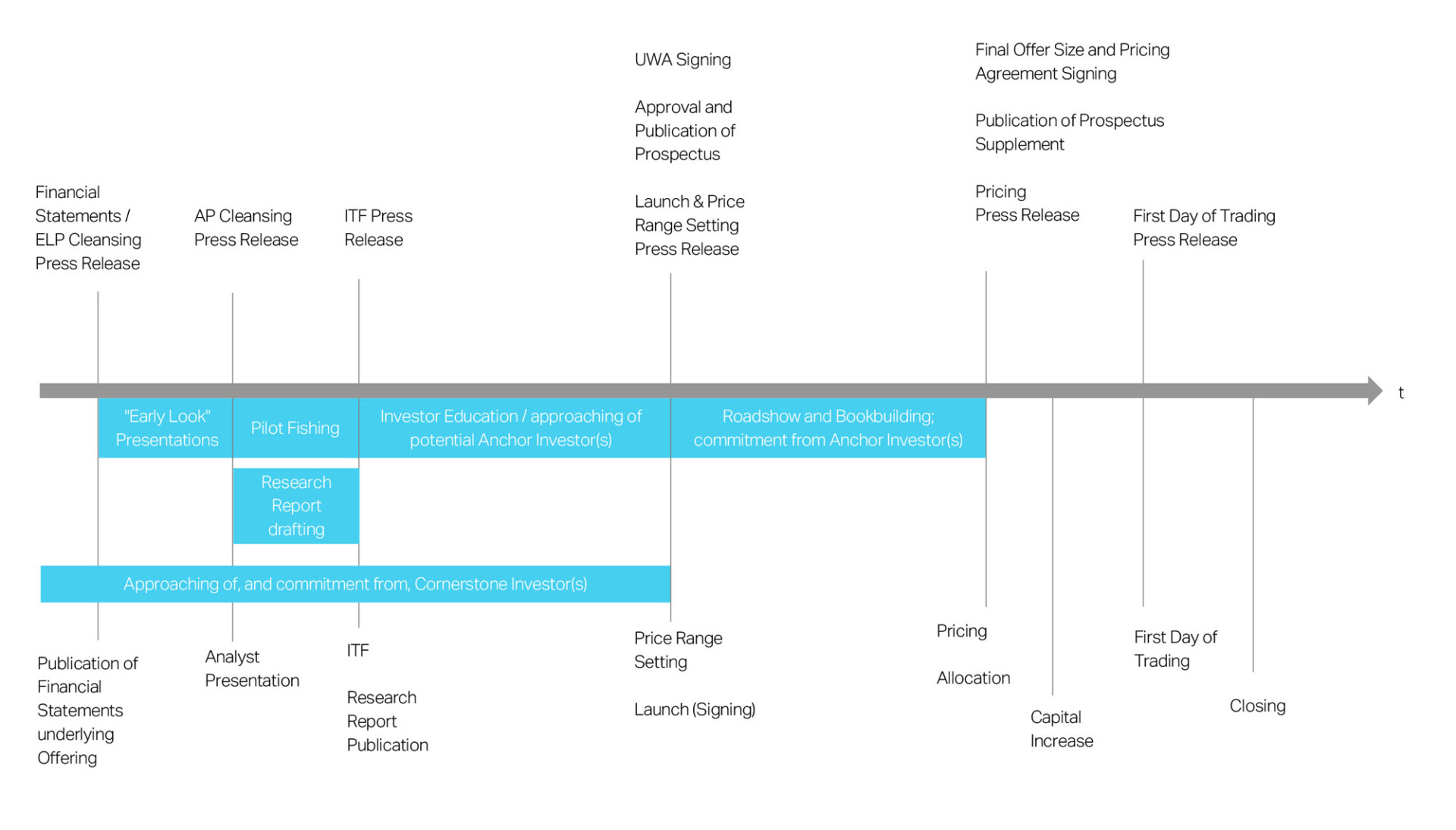
Prior to embarking on a SIX IPO roadshow and bookbuilding, which typically takes between 6 and 10 trading days (i.e., the offer period) based on a price range to be published in the IPO prospectus, a number of workstreams are carried out. Two of them stand out, in contrast to a US IPO:
i. Analyst Process
In the weeks prior to the IPO candidate publicly announcing its intention to float (the ITF) its shares on the stock market via an ITF press release, the analysts of the banks on the IPO syndicate are invited to prepare research reports in accordance with a meticulously defined procedure set out in the Research Guidelines and based on information to be made available in all material respects in the IPO prospectus. At the same time as the ITF press release is published, the analysts will publish their research reports, supporting – independently from the company – the investment decision on the part of prospective IPO investors.
ii. PDIE
Subsequently to the ITF press release having been published, potential investors may be approached in what is referred to as PDIE (see paragraph 1)b) above). This applies in particular to cornerstone and anchor investors: Legally binding commitments are now sought from cornerstone investors with the aim of disclosing their commitment in the IPO prospectus, such disclosure serving as favourable signalling bolstering the IPO. In contrast, anchor investors may well still place their orders in the order book after the launch, i.e., while the offer period has already commenced. The economic objective of the PDIE is to establish a price range (and to secure commitments from cornerstone investors) to be published in the IPO prospectus; to this end, the syndicate banks maintain a ‘shadow book‘ that reflects the ‘appetite‘ of the targeted investors as a function of the offer price and, in some cases, of the offer size.
b) Statutory SIX Prospectus Office Review Timeline
Pursuant to article 53(5) FinSA, the SIX Prospectus Office on a SIX IPO has a statutory timeframe of 20 days to review and approve the IPO prospectus (the Review Period). Because technically a new Review Period starts to run from each point in time a revised prospectus is being submitted – in response to SIX Prospectus Office comments or otherwise –, it is best practice to effect the first prospectus filing no less than one month prior to the start of the offer period (which is the point in time the prospectus needs to be approved, deposited and published).
The existence of a statutory Review Period, i.e., the legal entitlement to be granted approval of a FinSA-compliant prospectus within a predefined timeframe, is overall beneficial to the planning of a SIX IPO.
c) Proven ECM Ecosystem
While not strictly a legal argument, as set out in the introductory paragraph to this contribution, Switzerland boasts continental Europe‘s largest investor capital pool and, backed by world-class universities and a thriving innovation ecosystem, produces a consistent pipeline of high-quality IPO candidates across technology, life sciences, and financial sectors.
A SIX IPO with an offering to US QIBs pursuant to Rule 144A will typically feature the following offering participants: the issuer and its Swiss and US legal counsel, potentially the selling shareholder(s) and its/their Swiss and US legal counsel, a syndicate of banks (frequently sub-divided into Joint Global Coordinators, Joint Bookrunners and Co-Lead Managers or similar roles of seniority), their Swiss and US legal counsel, the issuer‘s auditors, a financial transaction adviser, potentially a PR agency, the share register, SIX and SIX SIS.
As was mentioned in the voiceover by certain panelists and participants at the Tech IPO Event, the cost of going public on SIX is comparatively low, when benchmarked against other leading markets. Underwriting fees in Switzerland currently range between 2% to 5% of gross proceeds, whereas in the United States they currently average 4% to 7%. Legal fees and regulatory compliance costs are also contained by Switzerland‘s proportionate, principles-based regulatory framework generally resulting in a more predictable, efficient, and issuer-friendly path to the public markets. Legal execution risks for issuers, including stemming from the interaction with the commercial register of the relevant canton in connection with the articles of incorporation and/or the Swiss Takeover Board in connection with any opting-out or opting-up from the mandatory PTO obligations, are generally manageable. In particular, cantonal commercial registers offer a hyperexpress procedure for intra-day registration of capital increases (see also paragraph 2)e) below).
d) Market-Standard IPO Documentation
The main documents to be prepared in connection with a SIX IPO are the underwriting agreement (the “UWA“) and the IPO prospectus. Each of these documents follows a well-established Swiss market standard. The UWA is executed at the same time as the prospectus is published: At the beginning of the offer period. At this point in time, only an offer price range and a maximum offer size is known, to be narrowed town to the offer price and the offer size once roadshow and bookbuilding have been concluded, culminating in pricing and allocation.
e) Post-IPO Access to Equity Funding by Means of ABB Offerings
Based on recent examples, the author of this contribution illustrated access to equity funding overnight by means of an ABB offering. For example, with wall-crossing of certain institutional investors ahead of the ABB, one issuer was able in February 2025 to raise CHF 300 million in such a transaction for general corporate purposes, and in March 2026 a well-known seasoned issuer in the insurance sector raised CHF 3,900 million to finance a previously announced acquisition – in each of these cases with an announcement of the ABB transaction at 5:45 pm CET of the first trading day and legally binding investor obligations having been entered into by 7:30 am CET of the second trading day. Thanks to the hyperexpress procedure referred to in paragraph 2)c) above, issuance and delivery to investors (against payment of the offer price, i.e., closing of the ABB) can occur and trading on SIX of the new shares can start as early as 9:00 am CET of the third trading day, catering for an overall expedited capital raising process.
Lorenzo Togni (lorenzo.togni@homburger.ch)
1 Lorenzo Togni, Moving the Goalposts Between Launch and Pricing oder Der Prospektnachtrag beim IPO unter bisherigem und zukünftigem Recht, in: Kapitalmarkt – Recht und Transaktionen XIV, Thomas U. Reutter/Thomas Werlen (eds.), Zürich 2019, pp. 57-91, p. 61.
2 SEC Release No. 34-104931, “Order Granting Directors and Officers of Certain Foreign Private Issuers an Exemption from the Filing Requirements of Section 16(a) of the Exchange Act“ of 5 March 2026, available at https://www.sec.gov/files/rules/exorders/2026/34-104931.pdf. For a synopsis of the SEC order, see Homburger client alert of 10 March 2026, “SEC Exempts D&Os of Swiss Dual-Listed FPIs from Insider Reporting“, available at https://www.homburger.ch/en/insights/sec-exempts-dos-of-swiss-fpis-from-insider-reporting.