
On 1 July 2025, FINMA Circular 2025/4 on consolidated supervision entered into force. This codification of FINMA‘s longstanding supervisory practice for financial groups in line with international standards enhances regulatory clarity. One year after its entry into force, it makes sense to assess the Circular‘s practical impact and the extent to which consolidated supervision has featured in FINMA‘s recent practice. As this issue will likely remain relevant in the coming years, this contribution examines FINMA‘s expectations as set out in the Circular and as applied in practice.
On 1 July 2025, the FINMA Circular 2025/4 on consolidated supervision entered into force. The Circular codifies FINMA‘s supervisory practice and clarifies the regulatory requirements applicable to the consolidated supervision of financial groups, in line with international standards. These standards were developed progressively by the Basel Committee after a series of crossborder bank failures in the 1970s and early 1980s, starting with Herstatt and Franklin National, and then the collapse of Banco Ambrosiano in 1982. Switzerland, as a member of the Basel Committee, has implemented these internationally recognized standards in its financial market regulations.
After a brief introduction (Section 1), the purpose of this contribution is to outline our understanding of FINMA‘s expectations in this respect, both as reflected in the Circular (Section 2) and in the practice of the Swiss financial regulator (Section 3).
1) Introduction
On 19 March 2025, FINMA published Circular 2025/4 Consolidated Supervision of Financial Groups under the BA and FinIA (the Circular), which entered into force on 1 July 2025. The Circular codifies FINMA‘s preexisting long-standing practice regarding the consolidated supervision of financial groups. This practice is primarily based on article 3b of the Banking Act (BA) and article 49 of the Financial Institutions Act (FinIA).
By formalizing its approach in the Circular, FINMA aims to provide greater legal certainty, while also stressing the importance the regulator attaches to this topic. Until now, FINMA‘s supervisory practice was communicated to the regulated institutions in the form of individual rulings, in which FINMA (i) confirmed whether the prerequisites for consolidated supervision were met and (ii) defined the scope of consolidated supervision (and the applicable requirements) for the relevant financial group. In addition, FINMA had published on its website a set of Frequently Asked Questions (FAQ) and had provided guidance to the auditors which, under the Swiss supervisory regime, act as the long-arm of the regulator.
The primary purpose of the consolidated supervision exercised by FINMA is to enable the regulator to assess the financial stability of institutions that form part of financial groups, by taking into account not only individual entities, but also the group as a whole.
The Circular classifies financial groups into the following categories:
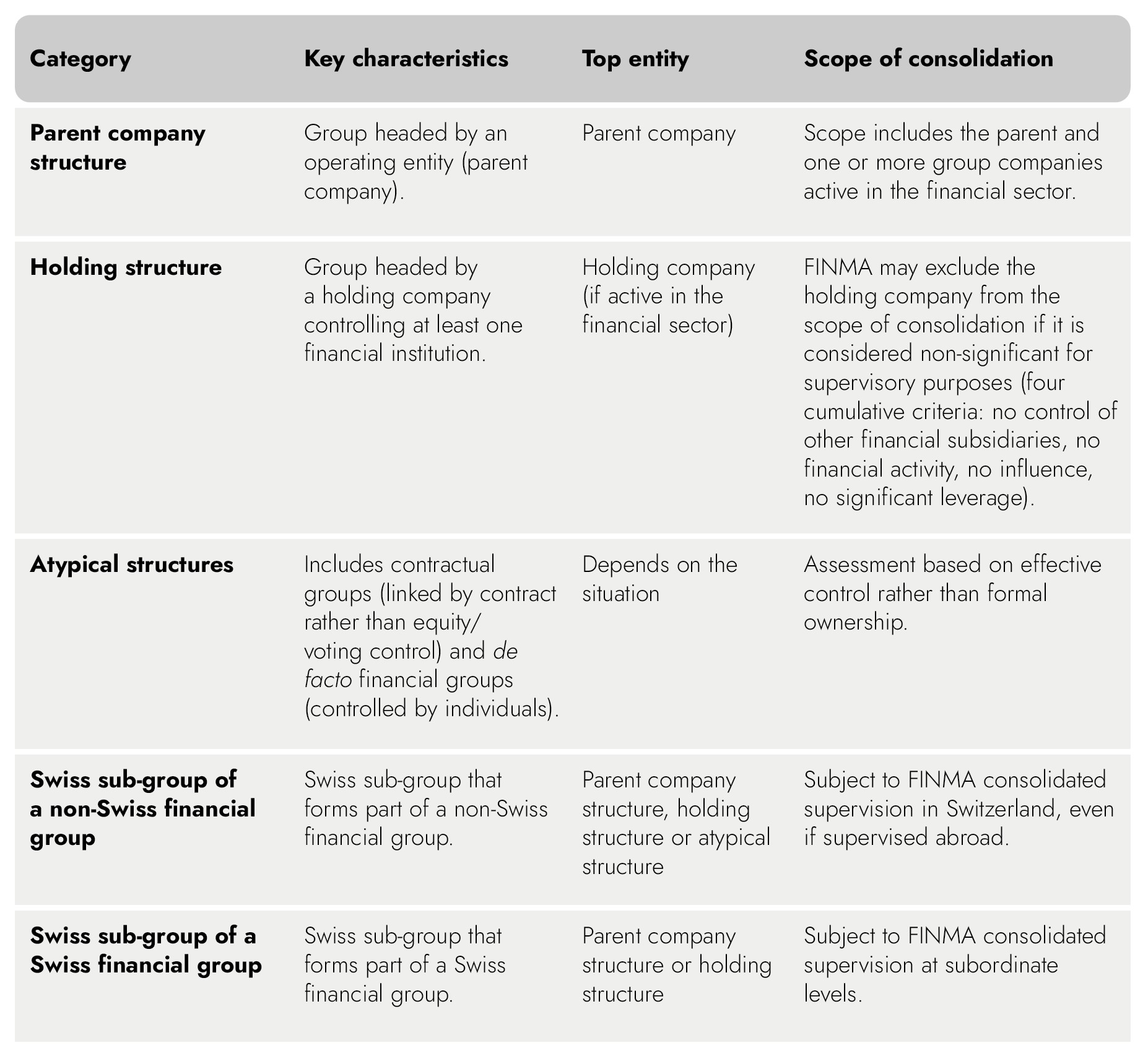
Of note, the regulatory scope of consolidation may, in practice, differ from the scope of consolidation from an accounting perspective, as the latter is determined under the accounting standards applied by the group. For international financial groups and conglomerates, additional consolidation regimes may apply.
2) Consolidated Supervision “in the Books“ (Circular 2025/4)
a) Which Entities Fall within the Perimeter of Consolidated Supervision?
i. The Rules in the Books
Consolidated supervision aims at enabling the financial regulator to understand the relationships that the various members of the group maintain with each other, including, at times, with the group‘s shareholders, and to ensure that the parent company has a clear understanding of all activities within the group along with the risks involved.
The position that a shareholder is not legally liable for the losses of a subsidiary also applies – at least in theory – in Swiss banking law. That being said, the decision to let a subsidiary fail may have a detrimental impact on all members of the group, in particular financially, reputationally or systemically. Therefore, the determination of whether a company (which is part of a group) is to be included within the scope of consolidation for regulatory purposes depends on two cumulative tests:
– whether it conducts activities in the financial sector (see sub-paragraph (1) below); and
– whether the entity concerned is part of an interconnected system (see sub-paragraph (2) below).
Where these conditions are met, the Circular specifies that the consolidated supervision exercised by FINMA generally covers all group companies that are active in the financial sector. This includes, in particular, special purpose vehicles (SPVs) that meet the specific requirements set out in the Circular for inclusion in the regulatory scope of consolidation. Consequently, in order to prevent SPVs established for off-balance-sheet issuances from being included within the regulatory scope of consolidation, appropriate safeguards must be implemented to ensure that the conditions outlined below are not met.
(1) Activity in the Financial Sector
The Circular provides for a broad definition of the terms “activity in the financial sector“, which covers the provision and intermediation of all types of financial services; it is not limited to activities subject to licensing or registration under the Swiss financial market regulatory framework. In addition, a substance over form perspective applies.
These terms include, among others, leasing, factoring, credit card activities, participation in issuances, custody of securities, payment services, as well as the issuance and custody of payment instruments. By contrast, group companies that are engaged purely in commercial, industrial or administrative activities are not considered to be active in the financial sector.
(2) Interconnected System
In order for two entities to constitute a financial group, they must form part of an “interconnected system“.
According to article 3c (1) (c) BA, an interconnected system exists where companies active in the financial sector form an economic unit or are linked by a legal duty or a de facto obligation to provide mutual support (Beistandspflicht).
An economic unit exists where a company directly or indirectly holds more than 50% of the capital or voting rights of other companies in the group, or otherwise exercises control over them. The Circular provides additional guidance on circumstances (listed non-exhaustively in the Circular) where control may be presumed through other means:
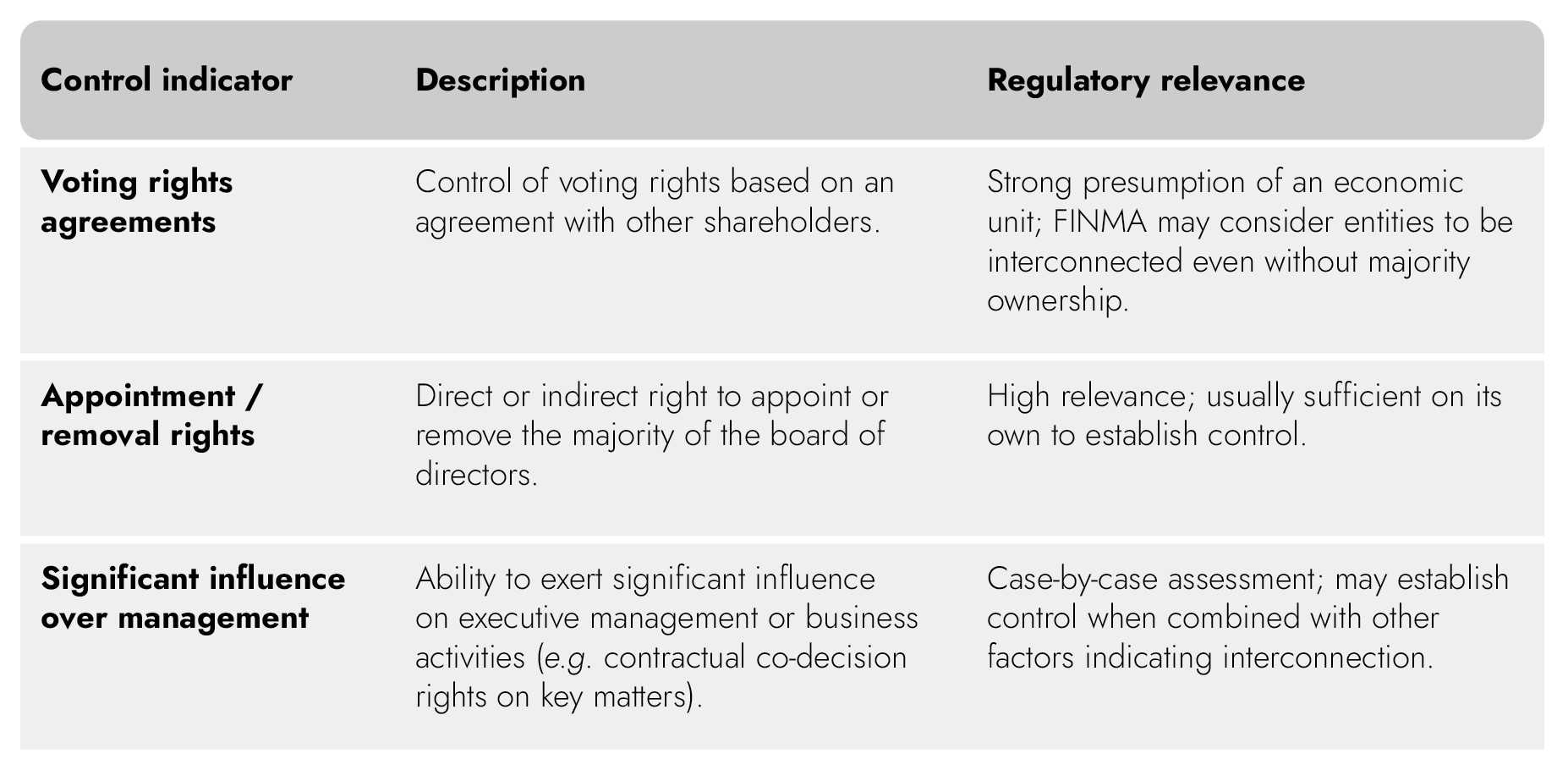
The inclusion of a company within the scope of consolidated supervision may also be triggered by circumstances pointing out a legal or a de facto obligation to provide support, which can, for example, arise from the following circumstances:
– strategic, personnel, organizational, or financial interdependencies;
– cooperation arrangements and dependencies;
– the use of a common company name;
– a uniform market presence; or
– comfort letters, “keep well“ agreements, or similar guarantees.
ii. The Rules in Practice: FINMA‘s Margin of Appreciation
The Circular indicates that FINMA has discretion in determining whether a financial group and/or certain entities should fall within the regulatory scope of consolidated supervision. This discretion also allows FINMA to grant regulatory exemptions in justified cases, including in the following situations:
– Exemption for non-material group companies: FINMA may exempt group companies active in the financial sector from consolidated supervision or declare that it applies only partially, where a company is not material for consolidated supervision purposes (article 23 (2) of the Banking Ordinance (BO)). In this context, FINMA may grant exemptions to group companies with respect to quantitative elements but not with respect to qualitative elements (see Section b) below). A typical candidate for the exclusion from the perimeter of consolidated supervision would be the General Partner (GP) of a private equity fund launched by a financial group.
– Implementation of ring-fencing measures: In exceptional cases, FINMA may waive the requirement for consolidated supervision and instead require the relevant financial group to implement ring-fencing measures, such as:
– corporate governance or structural measures aimed at strengthening the independence of the management and decision-making bodies of the institution vis-à-vis the financial group;
– financial measures aimed at protecting client assets or limiting the institution‘s financial interdependencies with the financial group; and
– the reduction of commercial interdependencies.
These measures, which are at times put in place for Swiss banking affiliates of foreign groups, are generally combined with specific reporting and disclosure obligations to FINMA.
b) What is the substantive content of consolidated supervision?
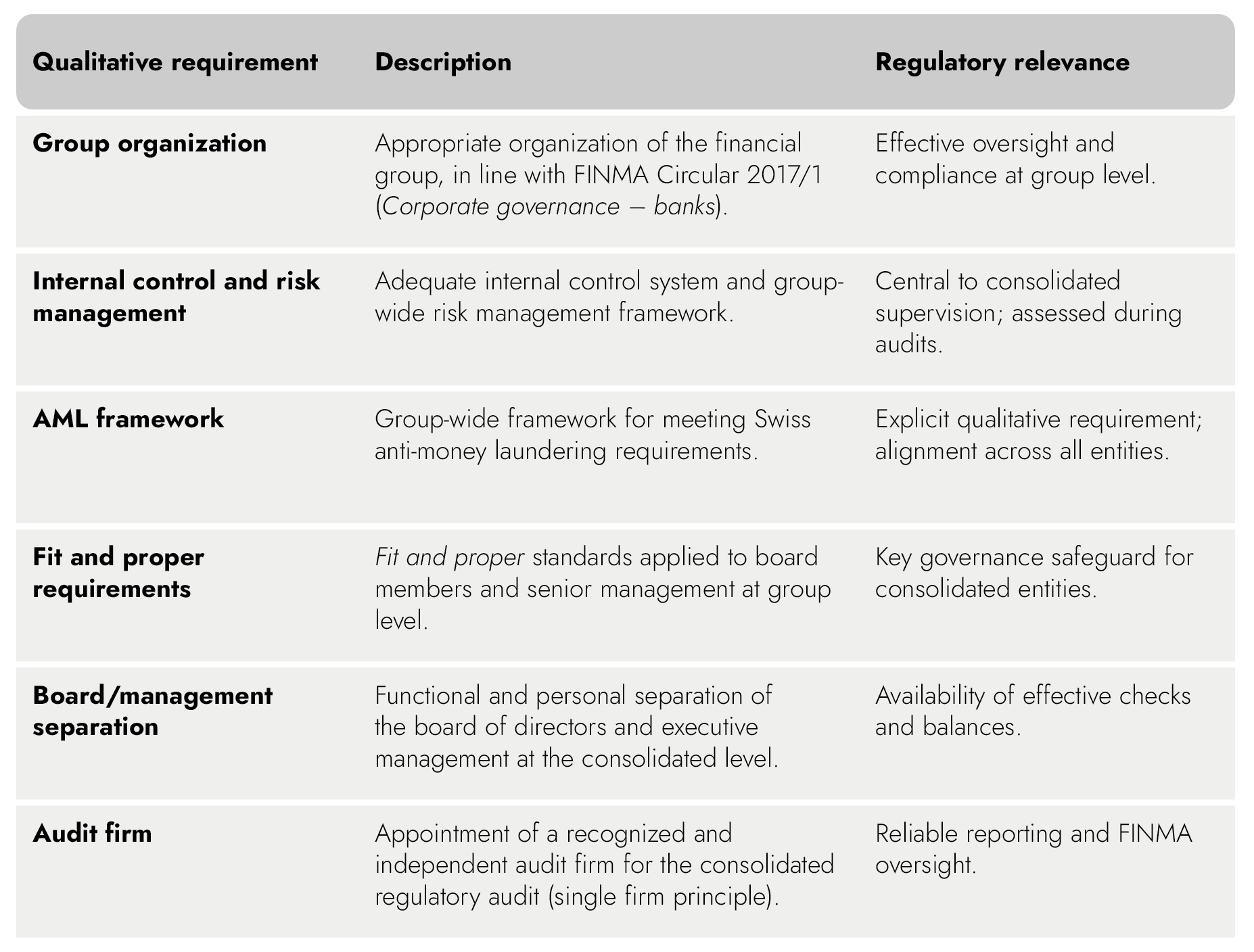
The substantive content of consolidated supervision comprises (i) qualitative elements and (ii) quantitative elements:
i. Qualitative Requirements
ii. Quantitative Requirements
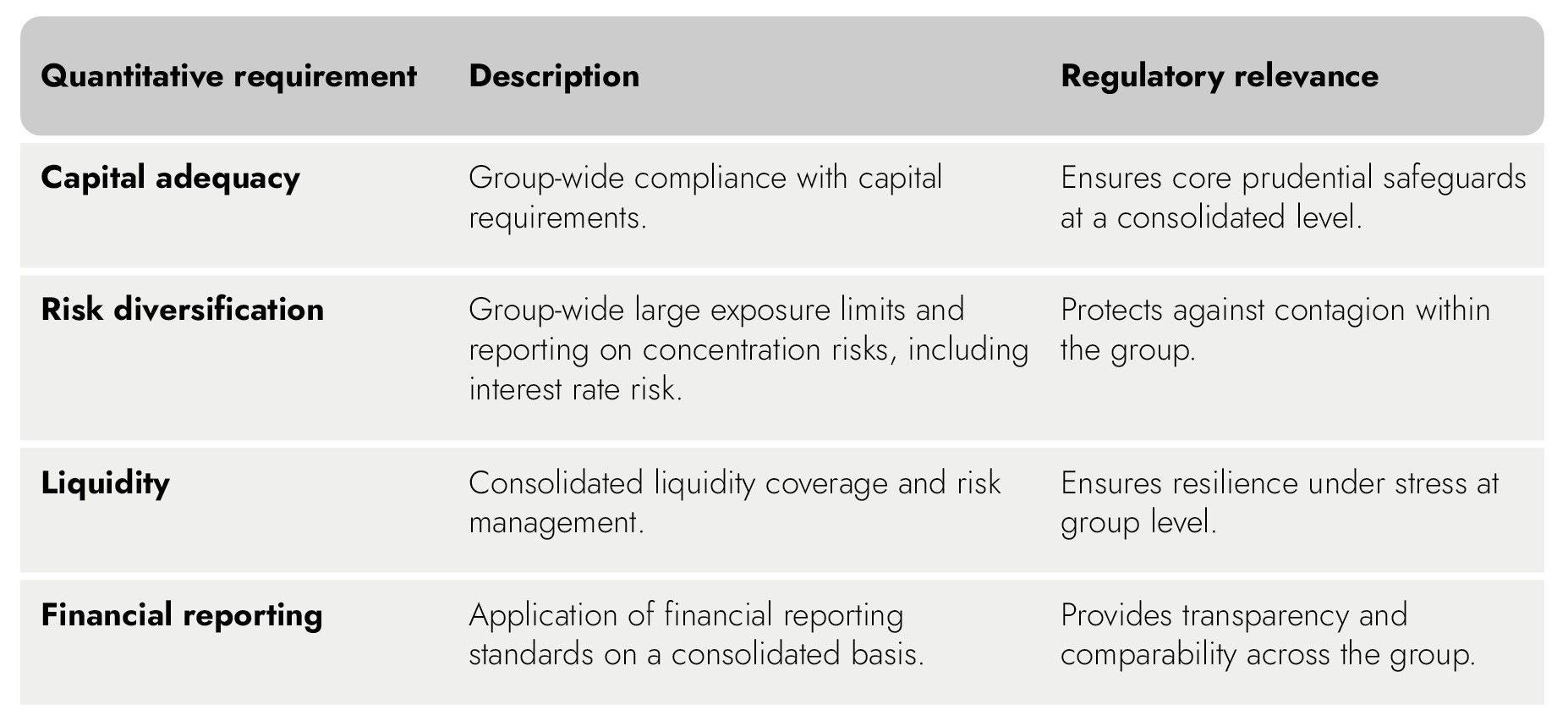
FINMA monitors compliance with both sets of requirements and designates a responsible entity within the group to ensure their effective implementation. The scope and intensity of the applicable requirements will ultimately depend on the group‘s structure and risk profile, and will be assessed by FINMA on a case-by-case basis.
c) Excursus: Insurance groups under the Insurance Surveillance Act (ISA)
Pursuant to article 64 ISA, two or more companies form an insurance group where (i) at least one of them is an insurance company, (ii) their activities in the field of insurance are predominant, and (iii) they form an economic unit or are otherwise connected through influence or control.
Not all insurance groups fall under FINMA consolidated supervision. Under article 65 ISA, FINMA may subject an insurance group with a Swiss member to group supervision if such group is effectively managed (i) from Switzerland or (ii) from abroad without being subject to equivalent supervision.
Pursuant to the new version of the FINMA Circular 2016/04 Insurance groups and conglomerates (para. 10 et seq) which entered into force on 1 September 2025, FINMA may place an insurance group under consolidated supervision if:
– The insurance group has an international character;
– The insurance group has a complex group structure (e.g. where the group has nested company structures, operates several business areas, or has intra-group links based on internal transactions); or
– For other important reasons (e.g. substantial market share in a product group, public interest in macro-prudential oversight of a group in the insurance sector, etc.).
In practice, only seven insurance groups2 are currently supervised by FINMA from a consolidated supervision perspective, which, on the basis of the current market situation, represents a clear minority of all insurance groups active in or from Switzerland.
3) Consolidated Supervision “on the Ground“
While the Circular codifies the main principles of consolidated supervision, it remains relatively high-level and does not expressly mention some of the expectations which FINMA has conveyed in practice to Swiss prudentially supervised entities.
Some lessons can be drawn from FINMA‘s recent practice in this area, where the authority has focused on (a) the definition of the regulatory consolidation perimeter, (b) group-wide governance and organizational structure, and (c) incident management.
a) Definition of the Scope of Prudential Consolidation
One area of focus for the regulator is the definition of the scope of prudential consolidation. FINMA examines whether the scope of consolidation has been correctly determined, from both a legal and an economic perspective. Companies are required to provide a clear justification of any exclusion of any entity from the group. In practice, this point is implemented within financial groups through the adoption of a formal consolidated supervision policy setting out the applicable criteria, supplemented by an exhaustive list of entities falling within the scope of consolidated supervision.
With regard to the definition of the scope of prudential consolidation, the following three points are of note:
– The main criterion for inclusion within the scope of consolidated supervision is control of more than 50% of the voting rights or capital, or corporate control on another basis (e.g. large (but minority) shareholders v. fragmented shareholding; influence over governance granted by a shareholders‘ agreement; this could typically be the case where a minority shareholder has a right to appoint a substantial number of board members). An alternative criterion is the duty to provide support, in situations where allowing a subsidiary to fail would harm the entire group – regardless of the general principle that a shareholder is not liable for a subsidiary‘s losses. This duty may arise from factual or legal circumstances, such as the interdependence of strategic, financial, organizational or human resources, or the use of a common business name or a uniform market presence (Circular, para. 34
et seq).
– Particular attention is also paid to special purpose vehicles (SPVs). FINMA examines whether these entities actually carry out activities that can be considered financial in a substantive sense. Financing vehicles and entities carrying out financial activities not directly related to banking are subject to particularly close scrutiny. The regulator expects the decision to exclude such an entity from the scope of consolidated supervision to be formalized and documented.
– An exemption may also apply where an entity is not material (see Section 2 (a) (ii) above). From an accounting perspective, participations in entities that are not significant for financial reporting or risk assessment purposes need not be included in the consolidated financial statements, provided that such non-consolidation is duly justified and disclosed in the notes (Circular, para. 89; article 33 et seq BO, in particular article 35 (1) (a) and (2) BO). FINMA has not established quantitative materiality thresholds; in practice, an assessment is generally performed by reference to indicative thresholds (typically around 5%) in relation to key metrics such as total assets, income, expenses and profit, as well as capital requirements, liquidity and client exposures from a risk perspective, subject to confirmation by the external auditors. From a prudential supervision standpoint, a similar quantitative approach is applied, complemented by a qualitative assessment, in particular where the entity does not carry out any substantive financial activity.
A further point of attention concerns sub-consolidation, and in particular the case of a Swiss sub-group forming part of a Swiss financial group within the meaning of para. 56 of the Circular. A practical illustration of this phenomenon – which appears to be uncommon in the Swiss financial market – is the situation of a financial group comprising private banking and asset management activities where FINMA decides to exercise its consolidated supervision, but at both the level of the financial group and at the level of the sub-group exercising banking or securities house activities. In such a configuration, the sub-group is itself subject to FINMA‘s consolidated supervision as a sub-group, in addition to the supervision exercised by FINMA at the level of the parent group. This gives rise to a double layer of regulatory consolidation, which may raise vexing practical questions: on the one hand, the precise outline of the scope of consolidation at sub-group level, which may differ from the scope applied at the level of the group as a whole; and, on the other hand, the consolidation obligation in respect of capitalization (see article 11 of the Capital Adequacy Ordinance (CAO)) and liquidity requirements applicable to the sub-group.
In practice, the entities concerned are required to formally document the consolidation retained at sub-group level and to ensure that the qualitative requirements applicable at the level of the parent group are also implemented at sub-group level. In our view, an exemption from consolidated supervision at sub-group level should nonetheless be granted where the sub-group is fully integrated into the governance, risk management, internal control system, AML framework and operational processes of the Swiss parent group, and where the consolidated supervision exercised at group level already adequately covers all relevant risks – such that the establishment of a specific consolidated supervision regime at sub-group level would not provide any additional prudential value. The principle of proportionality, which should underpin FINMA‘s actions, would in our view support such an approach. That being said, experience shows that FINMA tends to take a rather formalistic approach to the obligation of sub-consolidation for capital requirements purposes.
From a practical perspective, such an exemption from “sub-consolidation“ requires, in our view, that the sub-group be fully aligned with the group, both organizationally and functionally. The following elements should be looked at:
– The sub-group should not – and generally in practice will not – have a distinct autonomous strategy of its own; it will execute the strategy and business model defined at the group level.
– The management and supervisory bodies should be aligned between the group and the sub-group, with no autonomous governance structure specific to the future sub-group, so as to ensure a direct flow of information and consistency of decisions across both levels.
– Capital, liquidity and leverage requirements should be monitored, and risk management, compliance, internal audit and internal control functions organized and overseen, on a centralized basis at the group level, with no operational segregation of the sub-group.
If these prerequisites are met, the sub-group will have no strategic or governance autonomy of a nature that would justify the introduction of an additional level of supervision in the form of a consolidation requirement at the level of the sub-group.
b) Organisational Structure
The group‘s organisational structure (including its governance) is another key area of focus for the Swiss regulator.
Firstly, FINMA assesses whether the governance structures are appropriate and proportionate to the group‘s complexity. This review also covers functional reporting lines (in addition to the reporting lines within each legal entity). In this context, the internal regulatory framework must reflect a balance between (i) the accountability of local bodies (executive bodies and senior management) within each entity and (ii) the parent company‘s supervisory and intervention powers.
In practice, the holding company‘s influence over its subsidiaries can be exercised through two channels: (a) via group functions to which the corresponding local function reports (e.g. the local compliance function reports to the group compliance function) and (b) via representatives of the parent company who sit on the supervisory body of the subsidiaries. From FINMA‘s perspective, it is important that local management bodies assume their responsibilities autonomously (and have access to the information required to do so), even for functions that are otherwise integrated into a matrix structure at group level. To this end, institutions are expected to maintain up-to-date organizational charts and clearly document the distribution of decision-making powers and information flows (see also Section c below).
Secondly, FINMA requires that all group entities, including foreign and non-banking subsidiaries, be adequately monitored by the group‘s internal control system (ICS) and risk management framework on a consolidated basis, including for activities that are not per se regulated. This entails, at group level, the development of risk maps (e.g. for credit risk, market risk and operational risk), minimum standards and control plans. At local level, the minimum standards issued by the group must be implemented as a minimum standard, whilst taking into account any stricter rules applicable under the subsidiary‘s legal framework. In this context, the regulator attaches particular importance to the implementation of a unified internal anti-money laundering framework.3
c) Information Flow within the Group
Another key aspect concerns information flows (top-down and bottom-up). FINMA requires that information is transmitted via clearly defined and traceable channels, in accordance with the group‘s legal structure.
i. Top-down Information Flows
The group‘s holding company must have an internal structure that ensures that guidelines adopted at group level are communicated to local entities, which are responsible for implementing them locally. The group functions responsible for this area must then verify that the guidelines have been implemented, with the regulator emphasising the importance of regular on-site visits in this context (see article 6 (1) (d) of the FINMA Money Laundering Ordinance (FINMA-MLO)).
ii. Bottom-up Information Flow
The upwards chain of communication must be transparent and traceable. Escalation mechanisms must be formalized, and reports be validated by local governance bodies before being forwarded. In practice, consolidated reporting tools, including dashboards and standardized reporting templates, play a key role in demonstrating, on an ex-post basis, the effectiveness of the escalation system.
In this context, FINMA attaches particular importance to the management of incidents and irregularities. Institutions must demonstrate that they have effective processes in place to identify, report and remedy significant incidents, including breaches of internal rules and cases of fraud. A centralized incident register at group level is considered good practice, as are clearly defined escalation timelines and responsibilities. Corrective measures and follow-up actions should be systematically documented (in the minutes of group bodies and at the level of local entities) in order to demonstrate the effectiveness of controls over time.
4) Concluding Remarks
FINMA Circular 2025/4 codifies longstanding supervisory practice for financial groups, enhancing clarity without imposing additional burdens, while aligning with international standards. In practice, FINMA emphasizes perimeter definition, group governance, and bidirectional information flows. These are thus the areas warranting proactive adaptation by regulated institutions: financial groups should strengthen documentation, formalized escalation protocols, and unified risk frameworks to meet these expectations robustly. With the Circular having entered into force in July 2025 and now forming part of the regulator‘s official rulebook, further scrutiny and enforcement are to be expected in the near future.
Shelby du Pasquier (shelby.dupasquier@lenzstaehelin.com)
Philipp Fischer (philipp.fischer@lenzstaehelin.com)1
1 The authors would like to thank Mr Emmanuel Genequand, Partner at PwC, for his valuable input on an earlier version of this text. They are also grateful to Ms Victoria Glaus (Attorney-at-Law, Lenz & Staehelin) for her support and assistance in bringing this text into its final form. Any errors or omissions remain the sole responsibility of the authors.
2 The list is available here: https://www.finma.ch/en/~/media/finma/dokumente/bewilligungstraeger/pdf/vk.pdf?la=en&hash=14160A0E611439D902A2EE18359E1D3D.
3 In this context, it is worth recalling that the Swiss anti-money laundering framework applies to all commercial activities of a bank (even those which do not qualify as “financial intermediation“ in the strict sense). This point was recently stressed by the Supervisory Board of the Agreement on the Swiss Banks‘ Code of Conduct in its case law overview for the first semester 2025 (see Aperçu de la jurisprudence de la Commission de surveillance relative à l‘obligation de diligence des banques (1er janvier au 30 juin 2025), page 3).